George Livermore
-
Angelo's Naval Cutlass
Henry Charles Angelo (1780–1852) was the third generation of Britain’s leading fencing family. Grandson of Domenico Angelo and son of Henry Angelo the elder, he took over the London fencing academy in 1817 and in 1833 became Superintendent of Sword Exercise to the British Army. He is best remembered for his Naval Cutlass Exercises, created around 1812–1813 and soon adopted by the Royal Navy. Inspired by the broadsword methods, devised by his father, but simplified for shipboard combat, it provided sailors with a clear set of guards, cuts, and drills. Angelo later published the Infantry Sword Exercise (1842, reissued 1845), cementing his role in shaping British military sword training for decades.
So, Hoist your cutlass and step aboard HMS fort (st) Angelo for some Naval Cutlass Exercises, and try your hand at the very drills that kept Royal Navy sailors shipshape in close combat. We’ll chart a course through the core guard positions, tack across the main cuts, and then splice them together into drills that would’ve kept any deckhand ready to take on any scurvy dogs. No need to walk the plank—just bring a training cutlass or singlestick, a mask, and gloves. you’ll soon be sailing smoothly through Angelo’s fighting system. (Training cutlasses or Sabre simulators will be available to borrow).
Biography
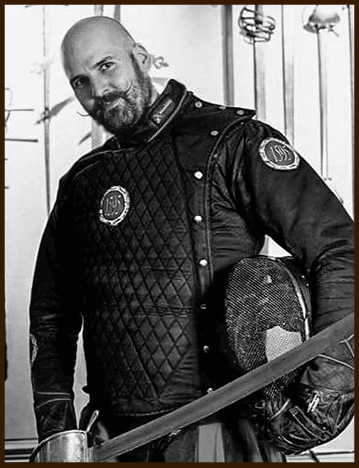
George Livermore is a Provost of the 1595. Club. He began his Martial Arts journey in 2002 in Brighton under the tutelage of club founder Chris Chatfield. In 2005 George became the 3rd Free scholar of the club and began his journey to become Provost, which he achieved in 2012. He has recently moved to Milan to open his own school and to pursue his journey towards earning the title of Master, for which he needs to teach a student to the level of Provost.
During his career, studies, and journey, he has participated and has been invited to teach at numerous events around the world: HEMAC Dijon, WMAW USA, MHFA… to name but a few. Teaching all forms from unarmed to dual weapons with staff weapons thrown in for good measure. Although the 1595. Club uses the treatise of Vincentio Saviolo as one of its main avenues of exploration for the art of fence, it is not limited to his teachings, and has evolved its martial system by incorporating other forms of Martial Arts, for example the bare-knuckle boxing of Victorian England, the French martial system of Savate, and other weapon based systems, including the naval sabre/cutlass treatise of Angelo, as well as contemporary classical sabre. The goal being to create a holistic and robust martial system using the martial principles and philosophy of Saviolo as a foundation on which to build our study.
Back to instructors